
Our vision
Fundraising should not run on guesswork
Public markets are priced by the second. Private markets — where most company formation actually happens — still move on PDFs, stale lists and who you happen to know.
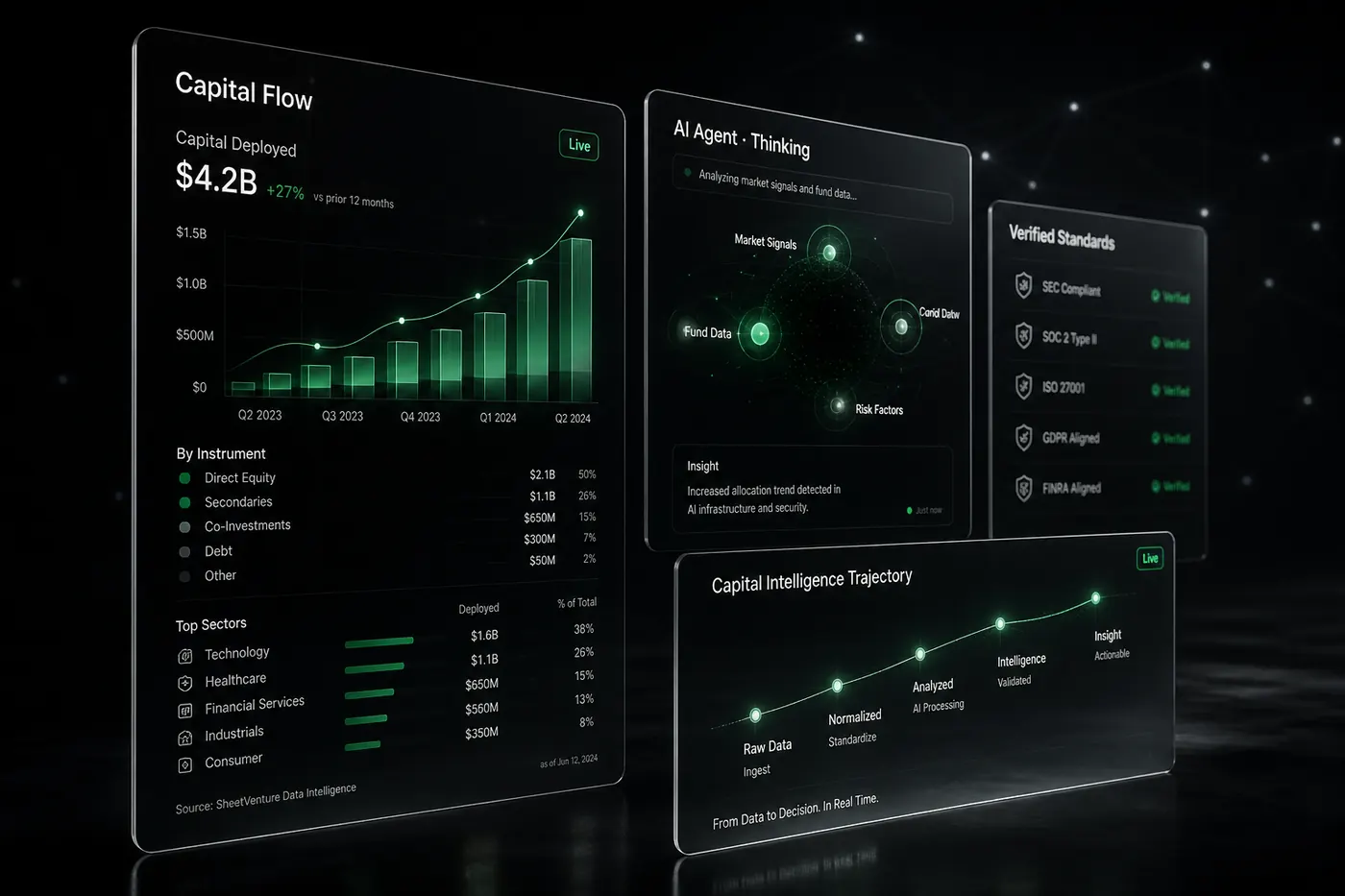
The thesis
The asymmetry is the product. A fund with a research team knows which investors are deploying this quarter; a first-time founder does not, and pays for that gap in months of wasted outreach. None of that information is secret — it is just scattered, unstructured and stale by the time it is assembled.
We think that gap closes the same way it closed in public markets: not with more data, but with data that states its own provenance, its own freshness and its own limits, so a decision can be defended rather than merely made.
Three shifts we are building for
01
From directories to signals
A list of ten thousand investors is not useful. Knowing which of them wrote a cheque at your stage in the last quarter is. The value moves from holding records to reading what the records are doing.
02
From search to answers
Most research questions are not queries, they are questions. The useful system answers them from records it can cite, and admits the boundary where its data ends instead of improvising past it.
03
From claimed coverage to published coverage
Every vendor claims completeness; none publishes the gaps. We think stating what is missing becomes a competitive advantage rather than an admission, because it is the only claim a buyer can verify.
The standard we hold ourselves to
A vision is only worth reading if it constrains what we ship. These are the constraints.
Every figure is checkable
Numbers on this site are generated from the database at build time. If one is wrong, it is wrong in a way you can prove — which is the point.
Limits are published, not buried
Where a field is sparse, the coverage page states the percentage. We would rather lose a sale to an honest gap than win one on an implied completeness we cannot back.
Answers cite their source
The research assistant grounds answers in our own records and flags when it reaches for the open web, so nothing arrives with unearned authority.
What we are building next
- A source URL on every funding round, so a single round becomes independently citable rather than something you have to take on trust.
- Deeper coverage of the people behind companies, where we can source it properly rather than inferring it.
- Coverage that keeps widening by geography and sector, published honestly as it grows rather than announced in advance.
Judge the thesis against the data
The coverage page is where this vision either holds up or does not. It states what we track, how current it is, and what is still missing.